Screen time & print
How to Reduce Toddler Screen Time Without a Battle
August 7, 2026
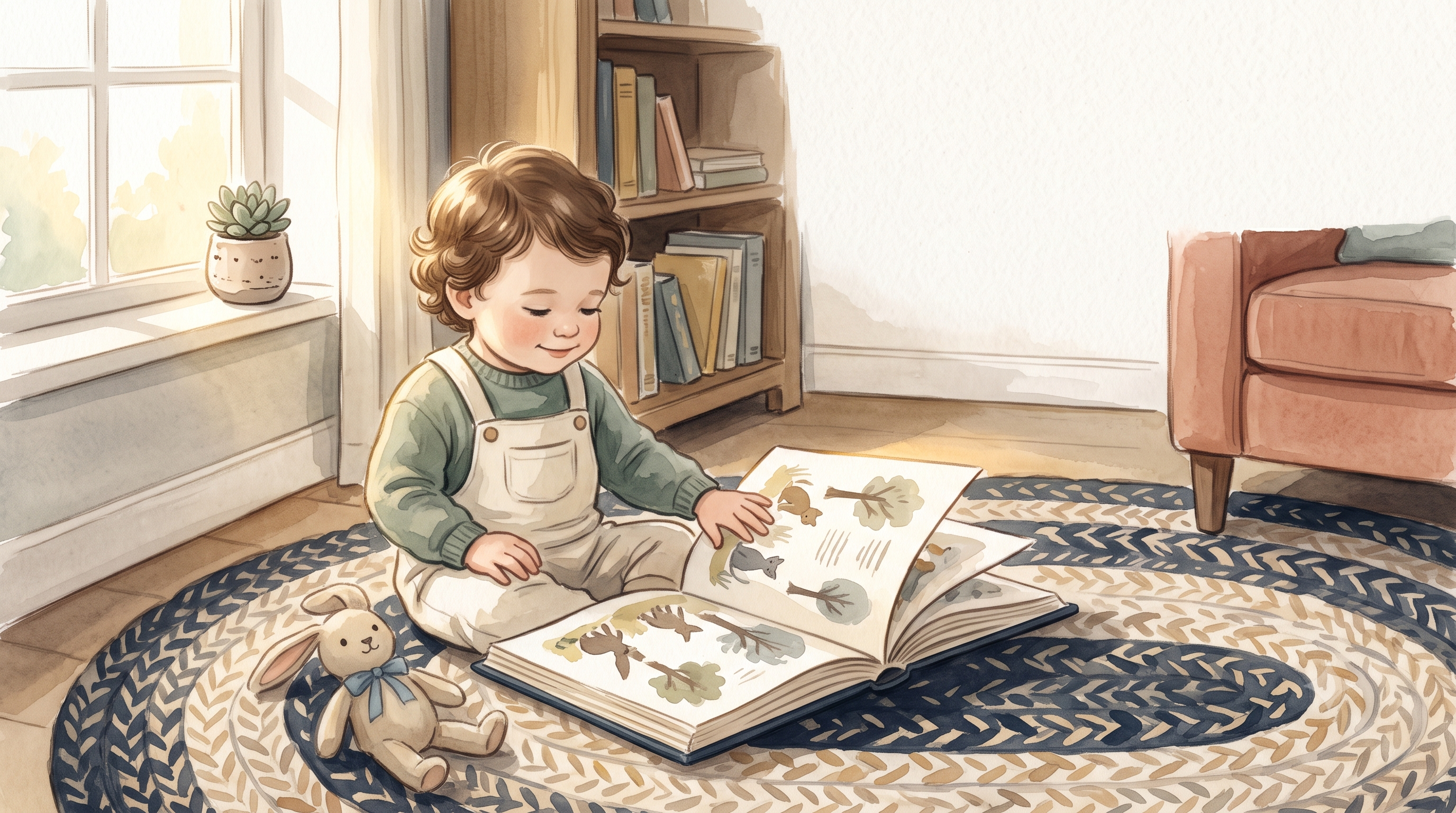
Cutting screen time doesn't have to mean a nightly meltdown. Here's a calm, expert-grounded way to replace screens (not just yank them) and land at a quiet bedtime book.
How to Reduce Toddler Screen Time Without a Battle
You already know your toddler is watching too much. What you actually want to know is how to dial it back without the screaming, the flailing, the small body going boneless on the floor the second the tablet goes dark. That part is the real problem. Less screen time is easy to agree to in your head and brutal to enforce at 5:45 on a Tuesday.
Here is the reassuring part. The fix isn't more willpower or a stricter rule. It's a better handoff. When you understand why the meltdown happens and what to put in its place, the battle mostly dissolves.
Why Cold Turkey Backfires (and What to Do Instead)
The instinct, when screen time feels out of hand, is to swing hard the other way. No more tablet. Done. But cold turkey treats the screen as the whole problem, when usually the screen is doing a job.
For most toddlers, the show isn't just entertainment. It's their off switch. It's how they come down from a big feeling, how they bridge a boring stretch, how they signal that the day is winding down. Yank it with nothing in its place and you haven't removed a habit. You've removed a coping tool and left a hole. The meltdown is the hole.
So the goal isn't to win a standoff. It's to make the screen less necessary. That's slower, and it works.
What the Experts Actually Say Now: AAP's Five Cs
If you grew up hearing "two hours a day, max," the guidance has moved on. The American Academy of Pediatrics has stepped away from a single time-limit rule toward an individualized framework it calls the five Cs: Child, Content, Calm, Crowding Out, and Communication. The shift is toward quality, context, and conversation rather than a stopwatch.
Two of those Cs do a lot of work for tired parents.
The AAP's Calm names a specific trap: kids often make media their main way to manage strong emotions or to fall asleep, and the work isn't to forbid that but to help them build other ways to settle. If the screen is your child's only calming strategy, the answer is to grow a second one, not to confiscate the first.
The AAP's Crowding Out quietly reframes the whole project. Instead of asking what you're taking away, it asks what you want to get back: family time, more sleep, outdoor play, time with the dog. That reframe matters more than it sounds. "Less screen" is a loss your toddler will fight. "More of the thing you both love" is a trade.
The AAP also offers a Family Media Plan to make these choices concrete for your household rather than leaving them to the worst moment of the day.
On the under-six years specifically, Zero to Three lays out a clear age map: avoid screen media entirely from birth to about 18 months, with video chat as the exception; introduce high-quality media with a grown-up watching alongside from 18 to 24 months; and from ages two to five, aim for roughly an hour a day of high-quality programming, watched together. The "watched together" part isn't a nicety. Zero to Three notes that a young child learns most from interacting with their parent, and that co-viewing, asking questions, pointing things out, tying the show to real life, is what turns screen time from passive into useful.
Replace, Don't Just Remove: The Core Principle
This is the whole post in one line. You don't subtract a screen. You swap it.
A toddler reaching for the tablet is reaching for something predictable, absorbing, and low-effort. If you want that hand to reach somewhere else, the replacement has to offer the same things. A pile of educational toys you suggest brightly while taking the tablet away does not. It's slower to start, it demands more of them, and it arrives wearing the face of punishment.
The replacements that work share three traits. They're easy to start, they hold attention without a fight, and they come with you in the room. Stacking cups while you narrate. A bath. A walk to find every red thing on the block. A book on your lap. Crucially, you're not asking your toddler to entertain themselves through the gap. You're filling it with you, which is the thing they were never actually getting from the screen.
The Transition Toolkit: Warnings, Timers, and Stopping Points
Most screen battles aren't about screens. They're about transitions. The cut from one absorbing thing to the next absorbing thing is the sharp edge, and a few small tools blunt it.
Warn before you switch. "Two more minutes, then we turn it off" gives a toddler's brain time to prepare. The abrupt black screen is the thing they're reacting to as much as the loss itself.
Make time visible. Toddlers have no felt sense of "five minutes." A sand timer or a visual timer they can watch shrink turns an invisible rule into something concrete, and concrete things are easier to accept.
End on a natural stopping point. Off at the end of the episode lands softer than off in the middle of one. The story finishing gives the ending a logic that isn't just "because I said so."
Hand them straight to the next thing. The most dangerous moment is the empty beat right after the screen goes dark. Have the bath running or the book already open. You're not negotiating across a void. You're moving them from one good thing to the next.
You Are the Model: Why Your Own Phone Habits Matter
This one stings a little. The research is fairly direct: peer-reviewed work has found that parents' own monitoring and limiting practices are inversely associated with how much screen time their kids get on weekdays, and, notably, that when parents cut their own screen use, their children's screen use tends to drop too.
Your toddler is studying you constantly. A house where the adults narrate the day from behind a phone is teaching one lesson while the rules say another, and toddlers believe what they see over what they're told. None of this is a guilt trip; it's leverage. Your phone habits are one of the few screen-time dials you fully control. Putting your own phone in a drawer during the wind-down does double duty, modeling the behavior and freeing your hands and attention for the kid in front of you.
Building a Calm Wind-Down That Ends With a Book
The single highest-value place to win this is the hour before bed, for two reasons backed by sleep researchers.
First, screens actively sabotage sleep. The Sleep Foundation notes that screens before bed suppress melatonin and make it harder for children to fall asleep, which is why experts advise shutting screens down about an hour before bedtime. Children who read at bedtime fall asleep more easily than those who finish the night on a show or a game.
Second, what you replace the screen with pays off well beyond that night. Research published in BMC Public Health found that children in families with consistent bedtime routines showed stronger working memory, attention, and school readiness compared to those without them. Separate longitudinal research has found that language-based bedtime routines — reading, storytelling, songs — are associated with longer nighttime sleep duration and better verbal development in preschoolers. The book isn't just a stalling tactic. It's doing real developmental work while your child winds down.
One specific warning is worth stating plainly, because so many exhausted families lean on it: Zero to Three explicitly advises against using TV shows or videos to put a child to sleep. It interferes with a child's ability to fall asleep on their own, and it replaces the calming, connected bedtime a child gets from a caregiver with a screen. The show that seems to knock them out is quietly undercutting the very skill you want them to build.
So aim the whole evening at a soft landing. Dim the lights. Screens off and out of sight about an hour out. Bath, pajamas, teeth. Then the part you both sink into: a book, your voice, the same closing every night. The repetition is the point. A predictable ending tells a toddler's body the day is over far more reliably than any show.
When the screen does go dark, the easiest swap is one your toddler actually reaches for. A quiet story they recognize as their own does that especially well. This is the small, gentle thing Estori was built for: you upload a photo and your child becomes the character of a story made just for them, read in a screen-down, dim-room bedtime reader meant for exactly this part of the night. A book is a book, but a book starring you is one a toddler leans into instead of away from.
When It Still Goes Sideways: A Low-Guilt Reset
Some nights none of this works. The timer goes off and they melt down anyway. You're wrung out and the tablet buys you twenty minutes of survival, so you hand it over. That's not failure. That's a Tuesday.
The five Cs framework is built to flex precisely because real life does. A hard day, a sick week, a long flight, these are not relapses, and treating them as moral failures only makes the whole project heavier than it needs to be. Reach for the screen when you genuinely need it, and let the next ordinary evening reset the rhythm.
What actually moves the needle isn't a perfect record. It's the steady pattern underneath, the warning before the switch, the screen off before bed, the book that closes the day. Hold that loosely and consistently and you'll look up in a month to find the battle has quietly gone out of it. Not because you fought harder, but because you gave your toddler somewhere better to land.
Sources
- Kids & Screen Time: How to Use the 5 C's of Media Guidance — American Academy of Pediatrics (HealthyChildren.org)
- Screen-Time Recommendations for Children Under Six — Zero to Three
- Understanding the Updated AAP Recommendations for Screen Time — CHOC Children's Health Hub
- Mothers' and fathers' media parenting practices associated with young children's screen-time: a cross-sectional study — NIH / PubMed Central (PMC6276169)
- Associations between parental rules, style of communication and children's screen time — NIH / PubMed Central (PMC4589944)
- The Benefits of Bedtime Reading for Kids — Sleep.com
- Reading Before Bed — Sleep Foundation
- Bedtime routines child wellbeing & development — BMC Public Health / PubMed Central (PMC5861615)
- A Longitudinal Study of Preschoolers' Language-Based Bedtime Routines, Sleep Duration, and Well-Being — Fragile Families and Child Wellbeing Study / PubMed (PMID 21517173)