Reading & early development by age
A Reading Guide by Age, 0 to 6: What to Read and What to Expect
August 7, 2026
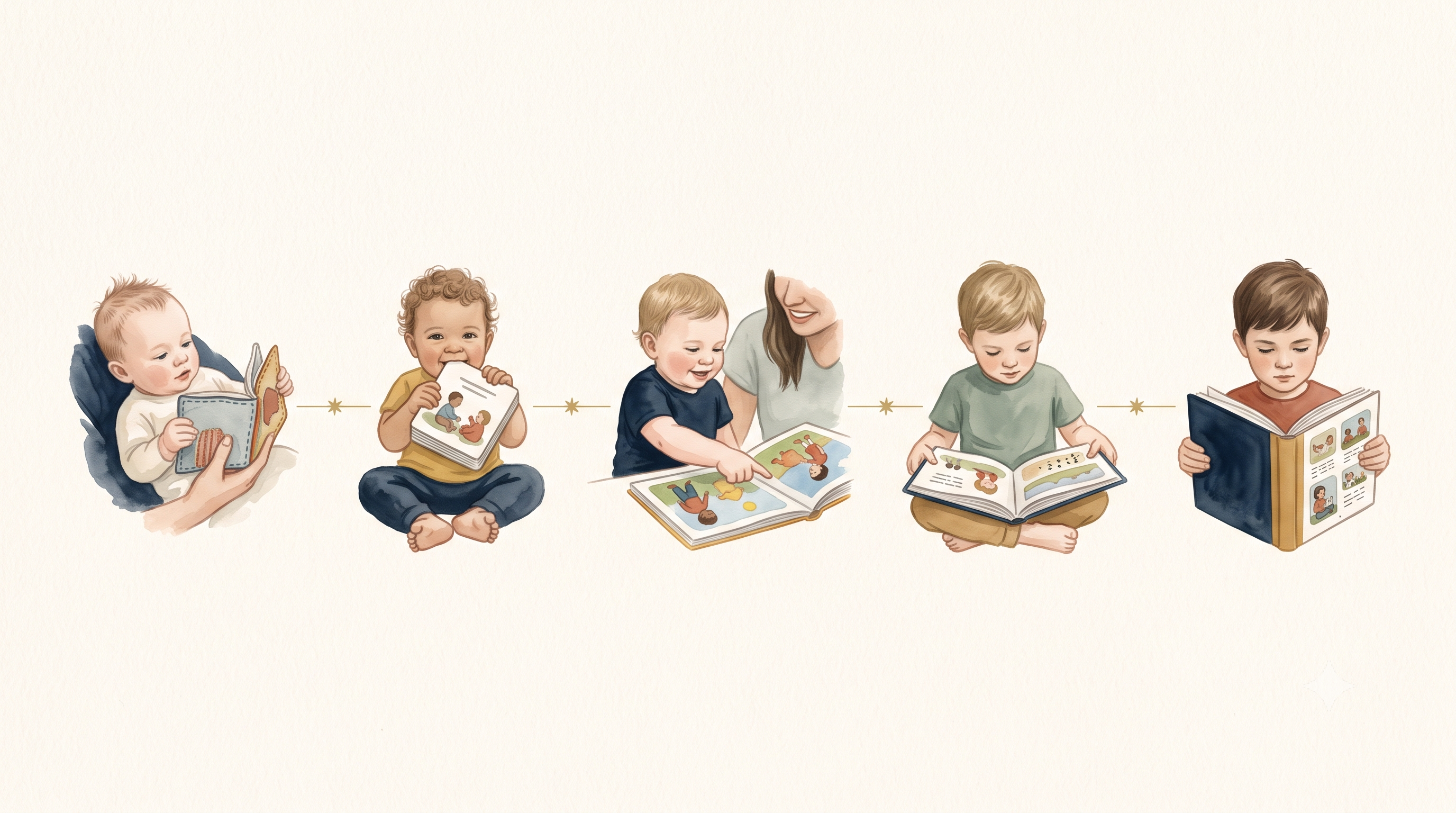
What you read to a six-month-old and what you read to a five-year-old should look nothing alike, and what counts as 'reading' changes just as much. Here is what to expect at each stage from birth to six, and how to pick books that meet your child where they are.
A Reading Guide by Age, 0 to 6: What to Read and What to Expect
You are probably not wondering whether to read to your child. You already sense it matters. The question is more like: is this the right book? Is my baby even getting anything from this? Should my three-year-old be sitting still longer? Those are the questions worth answering — and the answers shift dramatically from one stage to the next.
What counts as reading with a six-month-old looks almost nothing like reading with a five-year-old. The books change. The child's role changes. Your role changes too. Here is what to expect at each stage, and how to find books that fit where your child actually is.
Why Reading from Day One Matters More Than You Would Expect
Most parents know reading is good for kids. Fewer know how early the window opens.
In its 2024 policy statement — the first update since 2014 — the American Academy of Pediatrics recommends reading aloud with children beginning at birth and continuing through at least kindergarten. Not starting in toddlerhood. Not once they seem interested. From birth.
The reasoning runs deeper than vocabulary. Reach Out and Read notes that more than 80 percent of a child's brain is formed during the first three years of life, and shared reading actively supports healthy brain development during that window. Zero to Three adds that reading together starting as early as four months old increases the likelihood parents will keep reading as their child grows — and that language roots are forming in the brain before a baby can say a single word.
The AAP also observes that reading proficiency by third grade is a significant predictor of high school graduation and later career success. That outcome begins in a lap, with a board book, long before anyone is thinking about third grade.
0 to 12 Months: Books as Objects, Voices as Comfort
A newborn cannot follow a plot. That is fine, because that is not the point.
In the earliest months, what your baby is absorbing is your voice — its rhythm, its warmth, its rise and fall. According to NAEYC, reading aloud helps infants and toddlers build the vocabulary knowledge and world knowledge they will need to become skilled readers later. That process starts before they can sit up.
By around 6 to 12 months, something shifts. The American Academy of Pediatrics' early literacy milestone guidance notes that babies at this stage sit up, grab at pages, and put books in their mouths — and that this is a normal, healthy sign of interest. Board books, bath books, and cloth books work well here: durable formats with bold colors, simple objects, and photographs of faces. A baby mouthing a corner is not disrupting story time. That is story time for them.
The AAP advises prioritizing physical books over screens at this stage. Touchscreens tend to be passive or solitary experiences and lack the relationship-building of shared reading — the very thing that makes this stage so valuable.
1 to 2 Years: Pointing, Naming, and Turning the Page
Somewhere in the second year, books become interactive in a new way.
The AAP's early literacy milestone data describes the progression clearly. Around 12 to 18 months, a child points to pictures with one finger in response to "Where is the...?", carries books around the house, hands them to you to read, and recognizes when a book is upside down. That last detail always surprises parents — it means their child is already developing a sense that books have an orientation, a front and a back.
By 18 to 24 months, a toddler turns board-book pages independently, names familiar pictures when you ask "What's that?", and can fill in the ending of a familiar sentence when you pause mid-line. If you have read a book enough times that your child finishes it for you, that is not boredom — that is early literacy at work.
Research consistently shows that regular shared reading in the first year builds measurably larger vocabularies in toddlerhood. The books that look almost too simple — single images on each page, one word underneath — are doing real work.
3 to 4 Years: From Listener to Participant
Preschoolers bring opinions to books. They want the same one read again. They notice when you skip a page. They ask why. They wander mid-story and come back. All of this is developmentally on track.
This is also the stage where a technique called dialogic reading makes a measurable difference. Reading Rockets describes the approach as turning a read-aloud into a conversation: instead of reading straight through, the adult prompts the child with completion questions (pause before the last word), recall questions (what happened next?), and open-ended questions (what do you think she should do?). Research shows dialogic reading improves print awareness, oral language, vocabulary, and comprehension in preschoolers — and it works with any picture book your child already loves.
NAEYC notes that sharing books at this stage teaches children that pictures and words are symbols to be interpreted. Your child is learning that the marks on the page mean something — not just that you say words while holding paper.
5 to 6 Years: Following the Story and Finding the Words
Around kindergarten age, children begin moving from building the foundation for reading to doing something that starts to resemble reading itself. They track along with longer narratives. They predict what comes next. Some begin recognizing words they have seen before.
The AAP's 2024 policy update specifically recommends continuing shared reading through kindergarten — even once a child can read some words independently. That matters. The shared experience of reading together at this stage is not remedial support; it is how children encounter vocabulary, story structure, and the kind of language that does not show up in everyday speech.
The goal at this stage is not finishing books quickly or building toward a reading level. The goal is still, as it has been from birth, positive and enjoyable interaction with books — and with you.
What Normal Reading Actually Looks Like at Each Age
A note worth making plainly: what counts as "reading" looks very different at two than at five, and much of what parents worry about is actually right on track.
Zero to Three is clear that young children can only sit for a few minutes of a story at first. The attention span lengthens with age, and the primary goal at every stage is positive, enjoyable interaction — not finishing the book. Closing a book early because a toddler is done is not failure. It is reading correctly.
Some things that might look like disinterest are actually engagement: a baby mouthing pages, a two-year-old wandering off and returning, a four-year-old asking the same question on every page. These behaviors are not obstacles to reading. They are what reading looks like at those ages.
The AAP's developmental milestones are the clearest reference for understanding the range of what is typical. If your child is not yet hitting a milestone, one conversation with your pediatrician is worth more than any comparison to a neighbor's child.
How to Pick the Right Book for the Stage Your Child Is In
A few principles hold across the full range from birth to six:
Shorter is better early. For babies and young toddlers, a two-page book they engage with beats a long one that loses them. Zero to Three recommends meeting children where their attention is and letting them lead when they are done.
Repetition is a feature. Children return to the same books because repetition is how they learn. A toddler who wants the same board book five nights in a row is extracting something new each time — a word, a pattern, a detail they missed.
Interest beats level. A child who is fascinated by trucks will get more from a simple truck book than a more "advanced" book on a topic they find dull. Vocabulary grows best when children are engaged.
Physical books, especially at the youngest ages. The AAP advises that shared reading of physical books carries benefits that screen-based equivalents do not replicate, particularly for bonding and interaction.
Faces, rhythm, and simplicity for infants. High-contrast images, photographs of faces, and books with strong rhythmic language all suit the early months well.
Meeting Your Child Where Their Attention Is
One thing that often catches parents off guard: the right book for your child's stage is not always obvious from the cover. A story written for a three-year-old's world and attention span lands differently than one handed down from an older child. The same principle runs through Estori, which generates a story around your child's age and world — with their photo becoming the character — so it meets them where their attention already is rather than asking them to stretch toward something that was not made for them.
But whatever you read, the research points in one direction: the books matter less than the shared time. The AAP, Zero to Three, NAEYC, and Reach Out and Read all anchor their guidance in the same finding — that the relationship built across a shared book is the mechanism. The plot is almost beside the point.
Find a book your child will sit still for. Sit close. Read slowly. Pause when they point. The rest follows.
Sources
- Literacy Promotion: An Essential Component of Primary Care Pediatric Practice (Policy Statement) — American Academy of Pediatrics, Pediatrics
- Beyond Literacy: Shared Reading Starting at Birth Offers Lifelong Benefits — American Academy of Pediatrics / HealthyChildren.org
- Developmental Milestones of Early Literacy — American Academy of Pediatrics / HealthyChildren.org
- Read Early and Often — Zero to Three
- How to Introduce Toddlers and Babies to Books — Zero to Three
- Dialogic Reading: Having a Conversation about Books — Reading Rockets
- Child Development — Reach Out and Read
- Read Together to Support Early Literacy — NAEYC